Roux‑en‑Y Gastric Bypass (RYGB) is a benchmark bariatric procedure that reduces stomach volume and reroutes food to alter absorption and gut hormones, producing substantial and durable weight loss.
Gastric Bypass
The Procedure (Key Steps)
- You will be under general anaesthesia, which usually lasts for 2 to 4 hours.
- A small incision will be made, and a laparoscope (a keyhole camera) will be used to access your stomach.
- A gastric pouch, about 30 ml in size, will be created using stapling devices, which will separate it from the rest of your stomach.
- The small intestine will be carefully measured and divided into the right lengths to create new pathways. This process involves making two joints: one between the new stomach and the bowel, and another between the loops of the bowel. These joints are essential because they allow food to enter the intestinal tract and for the stomach acids and digestive enzymes from the bypassed stomach and the first part of the small intestine to mix with the food.
- A dye test (methylene blue test) will be performed using a small tube to check for any leaks.
- Once the test is complete, the instruments will be removed, your abdominal cavity will be deflated, and the cuts will be closed with absorbable stitches.
How It Works
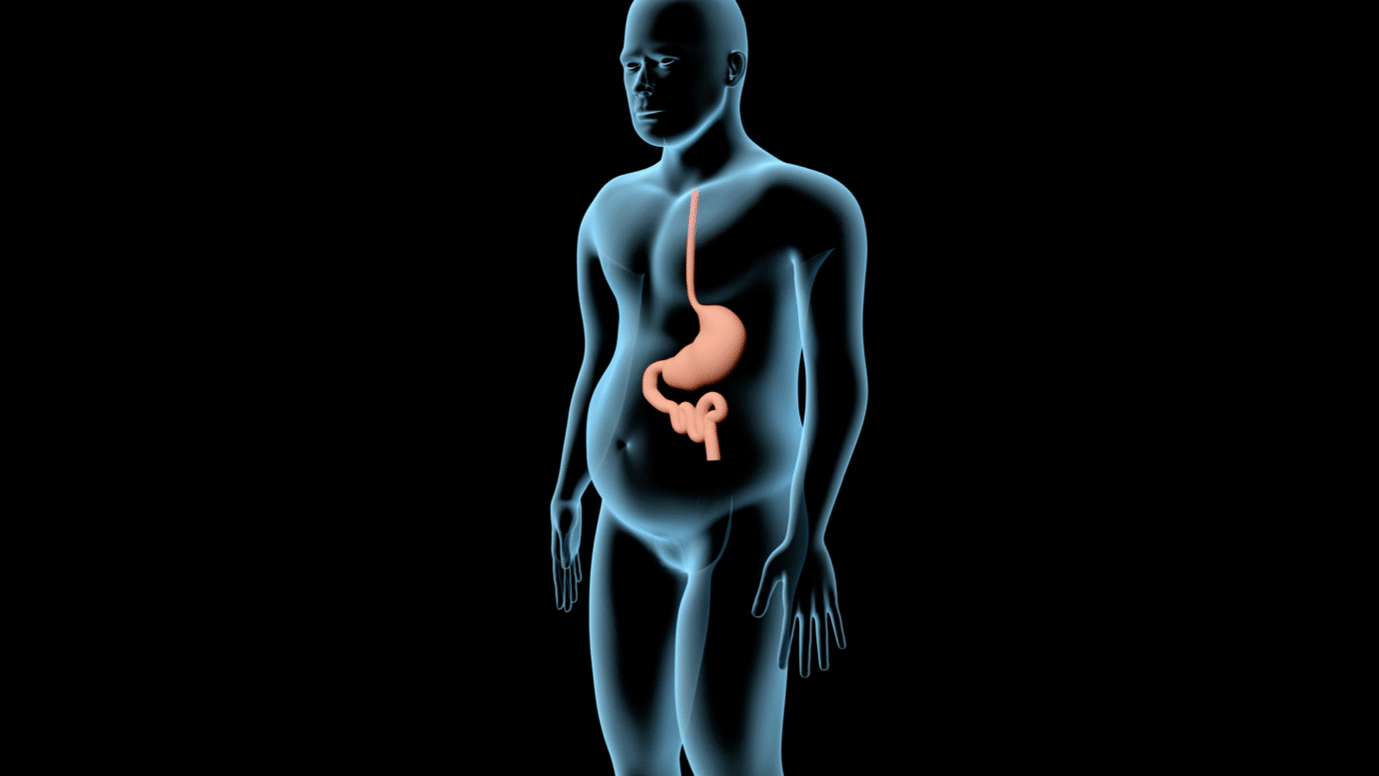
What happens to your anatomy
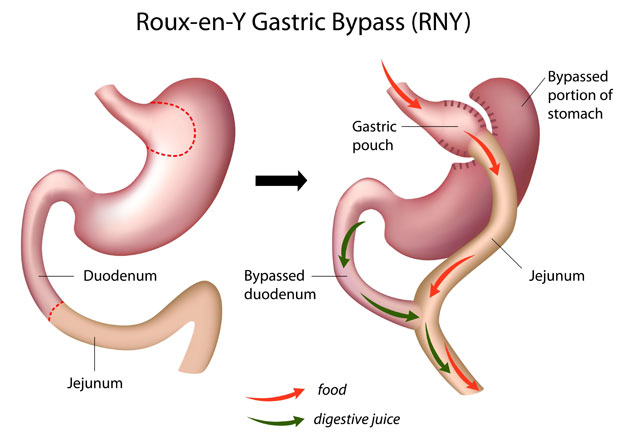
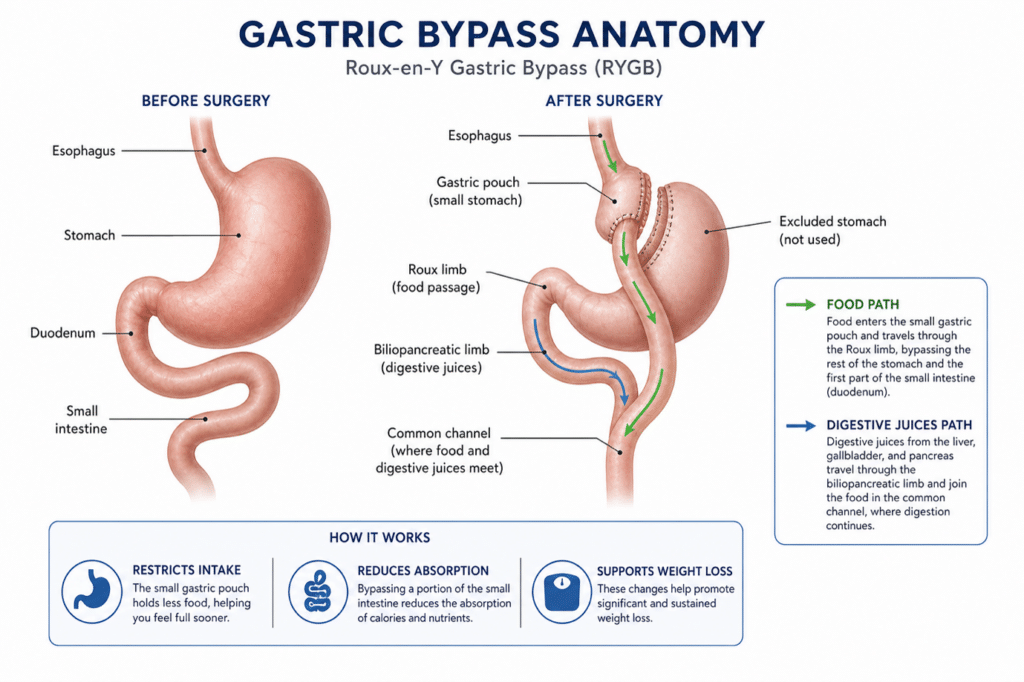
Gastric bypass (specifically the Roux-en-Y technique) makes two key changes:
- A small pouch is created – Surgeons section off a small part of the stomach to form a new, much smaller stomach. This is the only part food will pass through from now on.
- The bowels are rerouted – This new pouch is connected directly to a lower loop of the small intestine (called the Roux limb). Food skips over the rest of the stomach and the upper part of the small intestine entirely.
- Digestive fluids take their own path – The bypassed stomach and upper intestine don’t just disappear — they stay active and still produce digestive juices (bile and enzymes). These juices travel down a separate path (the biliopancreatic limb) and meet up with food further downstream, at what’s called the common channel.
Why this changes your hormones — and your hunger
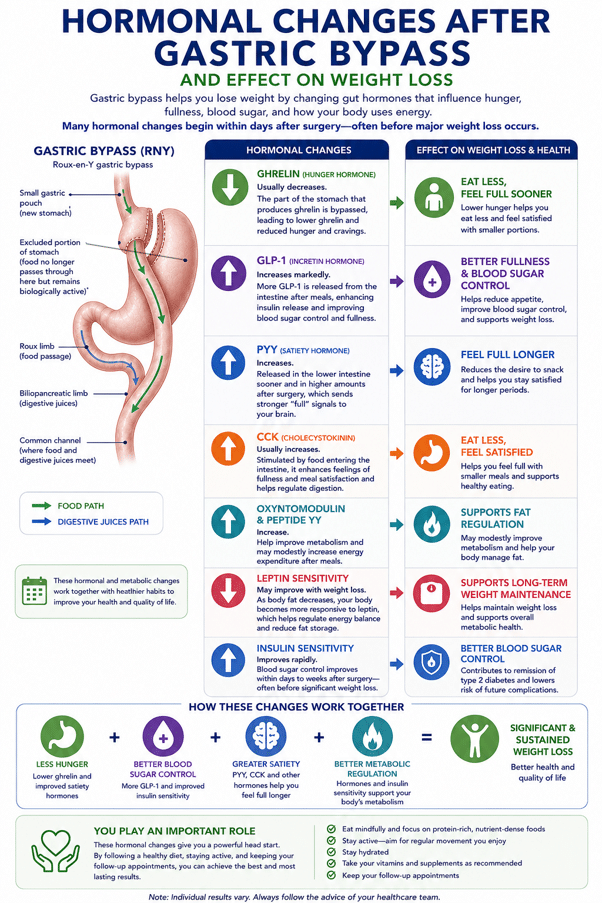
This is the part that surprises most patients: much of the weight-loss benefit isn’t just “you can’t eat as much.” It’s that rerouting the intestines changes the hormones your gut produces, often within days of surgery.
- Ghrelin (the hunger hormone) often decreases — because food no longer passes through much of the stomach where ghrelin is produced, many people feel less hungry after surgery.
- GLP-1 and PYY (fullness hormones) increase significantly — food reaches the lower intestine much faster, triggering stronger “I’m full” signals and helping you feel satisfied with smaller meals.
- CCK (cholecystokinin) may increase — adding to the feeling of fullness and satisfaction after eating.
- Insulin sensitivity improves rapidly — often within days of surgery and before significant weight loss occurs, helping blood sugar levels and type 2 diabetes improve very early after the operation.
How it all adds up
Less hunger, faster fullness, and better blood sugar control work together — supporting significant, sustained weight loss and long-term metabolic health, not just a smaller stomach.
Expected Outcomes After Gastric Bypass Surgery
Most patients can expect to lose approximately 30–35% of their total body weight within the first 18–24 months after gastric bypass surgery. Some patients may achieve greater weight loss depending on individual factors and long-term lifestyle habits.
Example
If a patient weighs 150 kg before surgery, they may expect to reach approximately 98–105 kg within two years.
Some patients may lose more weight. For example, reaching 95 kg would represent a weight loss of 55 kg (approximately 9 stone), which is an excellent outcome.
Health Benefits
Weight loss after gastric bypass is often accompanied by significant improvements in overall health. Many patients experience remission or meaningful improvement in conditions such as:
- Type 2 diabetes
- High blood pressure (hypertension)
- Abnormal cholesterol or blood fat levels (dyslipidaemia)
- Obstructive sleep apnoea
- Fatty liver disease
Important Note
Every patient is different. Your results will depend on factors such as your starting weight, medical conditions, dietary habits, physical activity, and long-term follow-up. Your bariatric team can help you understand what outcomes are realistic for you.
Risks and Complications
- Mortality ≈0.09–0.15%; early complication rate ≈5.9–6.8%.
- Early complication rate ≈5.9–6.8%.
- General complications: pain, bleeding, infection, unsightly scarring, and blood clots.
- Keyhole complications:
– Surgical emphysema: A crackling sensation in your skin caused by trapped gas. It’s usually not serious.
– Incisional hernia: A bulge near a cut caused by deep muscle layers failing to heal. It’s a risk of 1 in 100.
– Damage to other structures: Less than 3 in 1000 risk, especially if you’ve had previous operations. Your surgeon will discuss this with you.
– Conversion to open surgery: A risk of 1 in 100.
- Gastric bypass‑specific:
- Anastomotic stenosis (~2%)
- Staple‑line/anastomotic bleeding (~2%)
- Anastomotic leak (≈1–2%).
- Internal hernia/obstruction (~1%)
- Dumping syndrome
- Gallstones
- Suboptimal weight loss: A risk of 1 in 20
Nutritional deficiencies: B12, thiamine (B1), iron, calcium, vitamin D, copper, zinc, selenium, vitamin A
Why Mr. Spyros Panagiotopoulos?
With years of experience as a minimally invasive surgeon, Mr Panagiotopoulos is known for performing gastric bypass with great care, always putting the patient’s safety first and providing a well-planned follow-up to ensure long-term success.